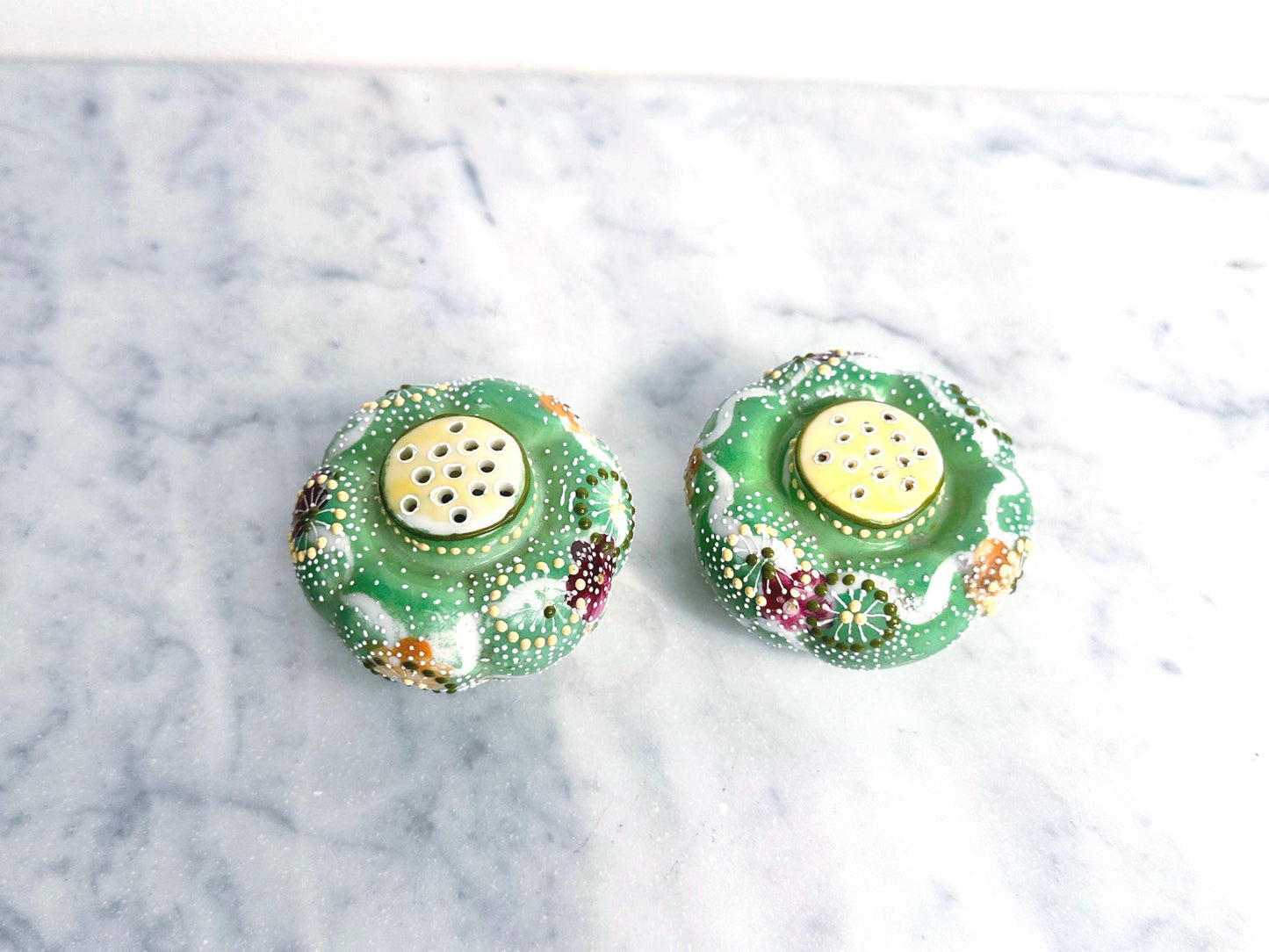
These Japanese Moriage salt and pepper shakers stop you in your tracks. Hand-built in Japan around 1900, they carry over a century of careful preservation in every detail — right down to the original cork stoppers still seated in the base of both pieces.
Moriage is a painstaking Japanese ceramic technique: liquid clay slip is drawn through a hollow bamboo tube and built up in raised beaded patterns, one dot at a time. Dense white and yellow enamel beading radiates outward from hand-painted floral centres in crimson, amber, and deep green against a rich jade ground. The lobed pumpkin form is characteristic of the finest moriage work of the period. Even the yellow disc tops are beaded — no surface was left plain.
Unmarked, consistent with genuine early Japanese export porcelain produced before or during the Nippon marking era. The quality of the moriage work and the survival of the original corks confirm their age and authenticity.
Put them on a considered table. Add them to a collection of early Japanese porcelain. Or simply keep them somewhere you'll see them every day — objects this carefully made deserve to be looked at.
MEASUREMENTS
Approximately 2 inches tall
Approximately 2.5 inches diameter
DETAILS
Maker — Unmarked Japanese export porcelain
Technique — Moriage raised enamel slip decoration
Era — Circa 1900–1920
Origin — Japan
CONDITION
Antique condition consistent with age. Original cork stoppers intact on both pieces. Light surface wear consistent with over 100 years of age. One shaker has a fine hairline crack on the top disc — visible on close inspection, not affecting structure or function. See all detailed photos.
RELIKTA
The name comes from the Latin relicta — something left behind. Each piece is chosen for its craftsmanship and quiet history, so these objects can continue their story in new homes and around new tables.